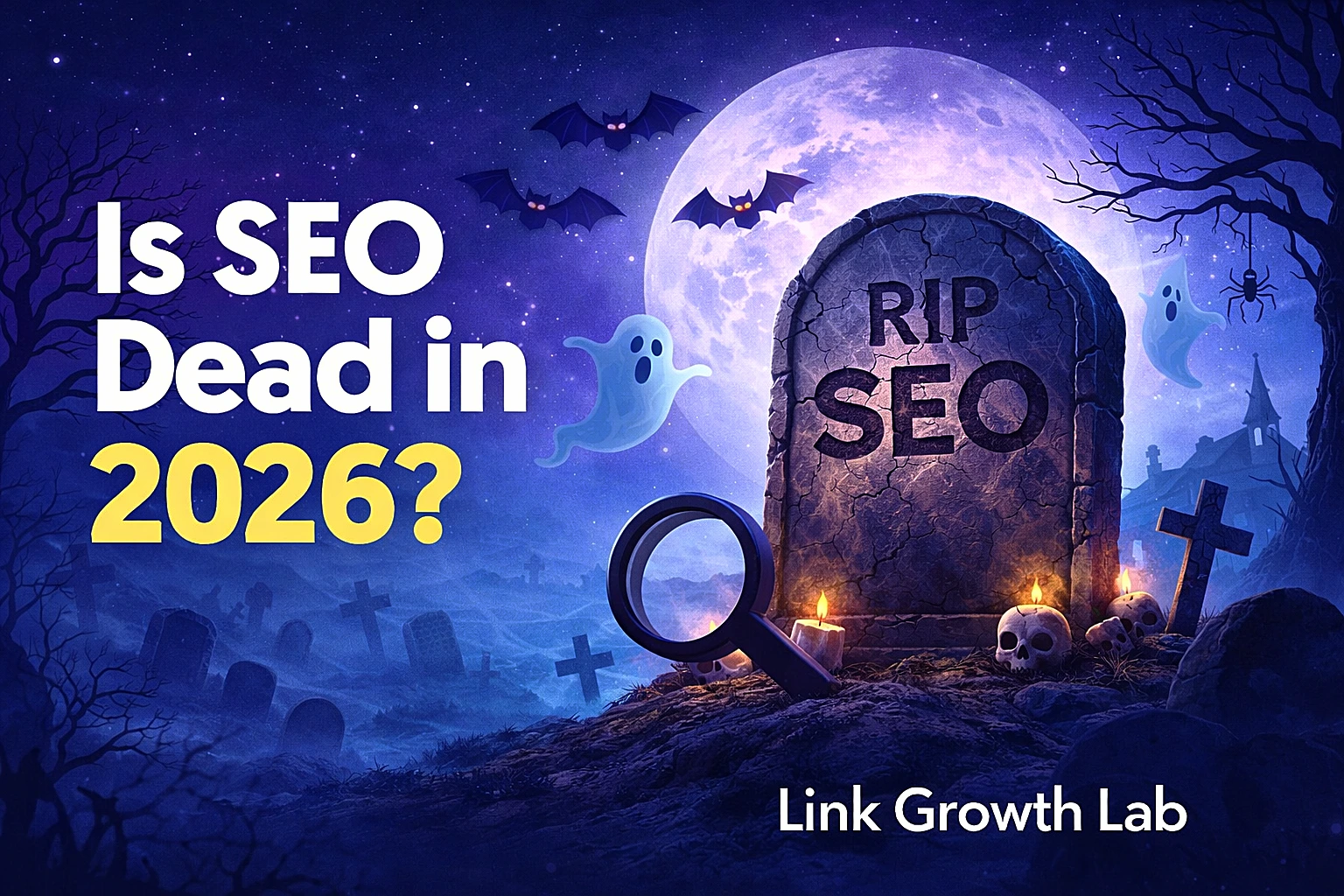
Every year, someone declares that SEO is dead. In 2026, the debate has intensified. With AI overviews dominating search results, generative answers appearing above organic listings, and large language models (LLMs) reshaping the way information is delivered, many marketers are asking: Is SEO dead in 2026?
The short answer is no. The longer answer is more interesting.
Search behavior has changed dramatically, but search itself is not outdated. Google still processes over 8.5 billion searches per day, and organic traffic is one of the most converting channels for businesses across industries. What has changed is how visibility works. Zero-click search, AI-generated summaries, and conversational interfaces powered by LLM have redefined what ranking means.
Traditional SEO tactics built entirely around keyword stuffing and mass link acquisition are fading. In their place, modern SEO strategies 2026 focus on objective precision, authority signals, structured content, and cross-platform visibility.
SEO is not dying. It is evolving into something more sophisticated, integrated, and strategic.
Table of Contents
What Changed in Search? From Google to Everywhere Search
Search in 2026 is no longer limited to ten blue links on Google.
AI overview and generative search results now summarize information directly within the search engine results page. This summary is powered by an advanced LLM that synthesizes material from authoritative sources. According to industry studies by SemRush and SparkToro, more than half of informational queries now trigger SERP features such as Featured Snippets, People Also Ask boxes, and AI-generated summaries. About 60% of Google searches result in zero clicks.
This does not mean that the traffic has disappeared. It means that the visibility has changed.
Users search beyond Google. YouTube operates as the second largest search engine globally. TikTok has become a search platform where Gen Z users actively seek out tutorials, reviews, and recommendations. Amazon dominates product-based search intent. Reddit threads rank prominently in Google because of the authenticity of their conversation. Voice assistants, powered by LLM, respond to queries spoken in natural language.
Search has become “search everywhere”. Therefore, SEO best practices 2026 require optimization across the entire ecosystem, not just Google’s organic listings.
Why SEO Still Matters (Backlinks, Authority, Intent)
Despite algorithm shifts and AI integration, three foundational elements continue to drive rankings: authority, intent alignment, and trust.
Backlinks are one of the strongest SEO ranking factors 2026. Ahrefs’ research consistently shows that top-ranking pages have significantly more referring domains than lower-ranking competitors. However, the emphasis is no longer on volume. Instead, Google’s algorithms evaluate link context, local relevance, and domain authority. In short, quality dominates quantity.
Search engines have also become remarkably effective at interpreting user behavior. Search intent ranking is now central to how content performs. Google’s AI systems evaluate whether a page actually satisfies informational, transactional, or commercial search queries. If the content doesn’t match the dominant intent pattern for the keyword, the ranking drops regardless of backlink strength.
Authority signals go beyond links. Google evaluates E-E-A-T: Experience, Expertise, Authority, and Trustworthiness. Clear authorship, credible references, and strong brand signals contribute to LLM-powered search engine credibility assessments.
SEO is not dead. Weak, outdated SEO is.
Modern Keyword Strategy for 2026
Keyword research in 2026 demands strategic depth. Gone are the days of chasing the highest volume keywords.
The foundation of modern SEO strategies 2026 is to balance search volume, competition and objective clarity. High-volume keywords often trigger AI overviews or heavy SERP features, limiting click-through rates. Medium-volume, high-intent keywords often convert better and face less algorithmic competition.
A smart approach involves clustering related questions into topic hubs. For example, a pillar page targeting how to get Google rankings in 2026 can internally link to supporting articles covering AI search optimization, featured snippet optimization, and how to build backlinks in 2026. This framework reinforces local authority, a key indicator assessed by LLM-based ranking systems.
The content should also include question-based questions. As generative AI systems summarize responses, structured responses are more likely to be cited in AI overviews. Incorporating concise definitions, contextual explanations, and meaningful distinctions increases visibility in both traditional and generative search results.
An effective keyword strategy today is about owning topics, not individual keywords.
How AI Impacts Search & SEO
Artificial intelligence is not replacing SEO; it is reshaping it.
LLMs now interpret search queries with contextual depth. Instead of literally matching keywords, they understand nuances, synonyms, and user behavior patterns. This evolution has given rise to AI search optimization and advanced generative AI SEO techniques.
AI-driven search engines prioritize structured, well-organized content. Clear headings, concise summaries, schema markup, and an authoritative tone make AI-generated responses more likely to be contextual. Pages that show local thoroughness and original insight perform better than shallow content.
The second transformation involves entity identification. LLMs understand entities, brands, people, places and evaluate how they connect in a knowledge graph. This means that brand building and digital PR now indirectly influence rankings by strengthening entity associations.
The rise of conversational search also means that long-tail, natural-language queries are growing exponentially. Voice search and AI assistants rely on conversational phrases. Optimizing content for natural language improves performance in these contexts.
Ultimately, AI enhances high-quality SEO. It penalizes subtle, manipulative tactics.
Technical SEO Fundamentals You Can’t Ignore
Even in an AI-driven world, technical SEO remains fundamental.
Core web vitals continue to influence performance. Metrics like Largest Contentful Paint and Cumulative Layout Shift measure user experience. Google has repeatedly emphasized that user satisfaction metrics are related to long-term ranking stability.
Mobile optimization is equally important. More than 60% of global searches happen on mobile devices. A site that loads slowly or displays poorly on a smartphone will struggle to compete regardless of the quality of the content.
AI summarization has made schema markup even more important. Structured data helps search engines interpret content more accurately. FAQ schema, article schema, and organization schema enrich results and improve eligibility for AI reference opportunities.
Technical SEO ensures that content can be found, understood, and ranked efficiently. Without it, even strong content can remain invisible.
Cross-Platform SEO (YouTube, TikTok, Voice)
SEO in 2026 goes far beyond Google.
YouTube optimization includes keyword-rich titles, descriptive summaries, and link signals. YouTube videos are often ranked in Google results, so cross-platform optimization increases visibility.
TikTok has emerged as a search engine. Captions, on-screen text, and voice narration contribute to discoverability within the platform. Brands that integrate keyword-aware short-form content gain exposure to younger audiences.
Amazon search optimization focuses on product relevance, reviews, and structured listings. For e-commerce businesses, Amazon SEO can drive higher-intent conversions than Google.
Voice search depends on the phrase of the conversation. Optimization for long-tail, question-based queries aligns with how LLM-powered assistants interpret spoken requests.
An integrated strategy ensures consistent brand messaging across platforms while supporting broader SEO best practices in 2026.
Link Building for 2026: Strategies That Still Work
The question of how to build backlinks in 2026 remains central to SEO success.
Link building now prioritizes digital PR and authority placement. Publishing proprietary data, research studies, or expert commentary attracts natural editorial links. Journalists and bloggers look for credible sources, and authoritative mentions signal trust to both users and search engines.
Guest posting also works when done strategically. Focus should be on relevant, high-quality publications rather than mass submissions. Contextual placement in meaningful content provides strong authority signals.
Linkable assets such as industry statistics pages, original surveys, or comprehensive guides continue to generate passive backlinks over time. In an AI-driven landscape, authoritative sources are more likely to be referenced in generative summaries.
Backlinks remain a powerful ranking factor because they represent third-party validation. In a world dominated by information-synthesizing LLMs, trust signals are more important than ever.
Measuring SEO Success: The Metrics That Matter
Traffic volume alone no longer defines SEO success.
Organic conversions, keyword visibility growth, and engagement metrics provide deep insights. Click-through rate becomes especially important in the age of AI overviews, as catchy titles must compete against immediate summaries.
Tracking how often content appears in SERP features or AI-generated results adds another layer of performance analysis. Visibility in featured snippets or AI citations increases brand awareness, even if click-throughs decrease.
Search performance should be aligned with business objectives. Revenue, lead generation, and brand authority remain the ultimate indicators of SEO impact.
Actionable SEO Plan for Agencies & Businesses
An effective roadmap to 2026 begins with a technical audit to ensure site health and structured data implementation. Next comes intent-based content mapping, aligning keywords with user journey stages. Content should demonstrate expertise, include structured formatting, and support AI search optimization.
Building authority through digital PR and strategic backlinks strengthens domain trust. Cross-channel expansion ensures brand presence on YouTube, TikTok, and other search-based platforms.
Consistency, authority, and adaptability define sustainable success.
Conclusion: The Future of SEO Beyond “Dead”
So, Is SEO Dead 2026?
Not even close.
SEO has transitioned from keyword manipulation to an authority-based, AI-based strategy. Modern SEO strategies 2026 integrate structured content, strong backlink profiles, cross-platform visibility, and user-first design.
Large language models have changed the way search engines interpret and present information, but they still rely on high-quality web content as their foundation. Businesses that invest in expertise, trust signals, and strategic optimization will continue to thrive.
SEO is not going away. It is becoming smarter, more interconnected, and more valuable.
FAQs
-
Is SEO dead in 2026 or still relevant?
No, Is SEO dead 2026 is largely a misconception. SEO remains highly relevant, but strategies have evolved that include AI search optimization, intent-driven content, and authority signals aligned with LLM-driven search engines.
-
What SEO strategies work best with AI-powered search engines?
Strategies focused on AI search optimization, structured content formatting, schema markup, topical authority, and high-quality backlinks perform best in an AI-powered environment.
-
How important are backlinks for SEO in 2026?
Backlinks remain a key element of SEO ranking factors 2026. However, the emphasis is on authority, contextual relevance, and editorial placement rather than just quantity.
-
What is the difference between traditional SEO and modern AI-SEO?
Traditional SEO focuses on keyword density and link volume. Modern AI-SEO emphasizes optimization for search intent ranking, structured clarity, entity authority, and LLM-generated summaries.
-
How do I optimize content for featured snippets and zero-click results?
Effective featured snippet optimization includes the use of clear headings, concise answer sections, structured formatting, and schema markup to improve suitability for SERP features and AI overviews.